Amendments to the Illinois Day and Temporary Labor Services Act Take Effect – What Temp Agencies and Contracting Companies Need to Know

Author Laura Friedel

On August 4, 2023, Illinois Governor JB Pritzker signed into law HB 2862, which significantly amends the Illinois Day and Temporary Labor Services Act (the “Act”). The amendments, which took effect immediately, provide most temporary workers with increased equal pay rights and include new safety and training requirements. Shortly thereafter, on August 7, 2023, the Illinois Department of Labor (“IDOL”) adopted emergency rules to provide additional details and clarifications regarding the amendments. It is important to note that the Act does not apply to professional and clerical temporary workers.

Among the most notable changes in HB 2862 and IDOL’s related guidance are:

  • Equal pay and benefits. Temporary laborers assigned to work at a third-party company for more than 90 calendar days (whether consecutively or intermittently) within any 12-month period must be paid at least the same wage as the lowest-paid comparable direct-hire employee and must receive equivalent benefits as comparable direct-hire employees. If there is no comparable direct-hire employee, the temporary laborer must be paid at least the same wage and equivalent benefits as the lowest-paid direct-hire employee of the third-party client.

IDOL guidance clarified that the 90-day clock starts to run after HB 2862’s effective date of August 4, 2023. If compensation increases are required to comply with the Act’s requirements, the increased wage will apply as of the temporary laborer’s 91st day working at the third-party client.

  • Cash in lieu of benefits. Temp agencies may choose to pay the temporary laborer the cash equivalent of the actual cost of the benefits rather than providing the benefits. IDOL clarified that “benefits” means health care, vision, dental, life insurance, retirement, paid and unpaid leave, other similar employee benefits, and employee benefits as required by state and federal law.
  • Information to be provided by third-party clients. Businesses that use a temporary laborer for more than 90 days must provide the agency with the necessary information related to job duties, pay, and benefits of direct-hire employees to enable the agency to meet its obligations related to equal pay and benefits.
  • Right to refuse assignments. Temporary agencies cannot send temporary laborers to third-party clients engaged in a strike, lock-out, or similar labor dispute without notifying the temporary laborer, in writing, of the labor dispute and the laborer’s right to refuse the assignment. IDOL guidance confirms that the right to refuse must be honored without prejudice.

IDOL guidance provides that the temporary agency must ask the third-party client whether a strike, lock-out, or other labor dispute exists at the client’s business before sending a temporary laborer to work there.

  • Workplace safety requirements. Before assigning a temporary laborer to a third-party company, the agency must inquire about safety and health practices at the worksite, provide training on general safety and recognized industry hazards, transmit a general description of the safety program at the start of the contract with the third-party client, provide IDOL’s safety hotline number to the temporary laborer, and inform the temporary laborer of how to report safety concerns.

The third-party company utilizing temporary laborers must document and inform temporary laborers about potential workplace hazards, review the agency’s safety training program to confirm it addresses recognized hazards, provide specific safety training for the worksite, and document and maintain safety training records.

IDOL guidance confirms that the safety training must be provided at no cost to the temporary laborer.

  • Expanded enforcement and penalties. The amendments allow any “interested party” to report violations and bring an action against the agency or client company. An interested party may include organizations that monitor compliance with worker safety, wage and hour laws, and other statutory requirements. Violations of the Act may result in penalties up to $18,000 per violation.

Proponents of the amendments to the Act indicate that it is intended to bolster workplace safety and compensation for temporary laborers, in addition to enhancing communication between agencies and their clients. Both agencies and contracting companies should review their policies and procedures related to temporary work to ensure compliance.

Attorneys in LP’s Employment & Executive Compensation Group will share additional information on the new requirements – for both temporary agencies and the company clients that use temporary laborers – at our upcoming Annual Employment Law Webinar.

Register for our complimentary Annual Employment Law Webinar.
NLRB Makes It Easier for Unions to Organize Staffing Employees

The National Labor Relations Board just made it much easier for unions to organize employees of staffing firms – sometimes called temp agencies.

It used to be that both the staffing firm and the client had to consent before a union could represent a group of employees that included both staffing firm employees and your regular employees.

However, under the NLRB’s new standard, consent isn’t required.  This means that a union can lump together staffing firm employees and regular employees, even though they are employed by different companies and viewed and treated as separate groups.

Under the NLRB’s decision, unions will also have an easier time organizing all of a staffing firm’s employees, regardless of where they work or are assigned.

As a result of the NLRB’s decision, unions will have a far easier time organizing.

So what can you do? Here are 3 steps all Companies that work with staffing firms should take in response to the NLRB’s new standard:

  1. Ask your staffing firm what steps they’re taking to improve employee satisfaction and avoid unionization, keeping in mind that the lowest cost provider may bring with it lower employee satisfaction and higher risk of unionization.
  2. Take a close look at your company’s union avoidance efforts. Make sure that you’re paying attention to all employees – both direct and those through staffing companies – and consider stepping up your union avoidance efforts by educating your team about the realities of unionization and how to spot organizing campaigns.
  3. Finally, make sure your agreement with your staffing firm includes a cooperation clause so that, if there’s an organizing campaign, you’re in the best position to work together quickly to respond.

In avoiding unions, the best defense is a good offense.  Take steps now to ensure that you – and your staffing firms – are in the best position possible to avoid union organizing efforts.

NLRB Expands Who May be Considered a “Joint Employer”

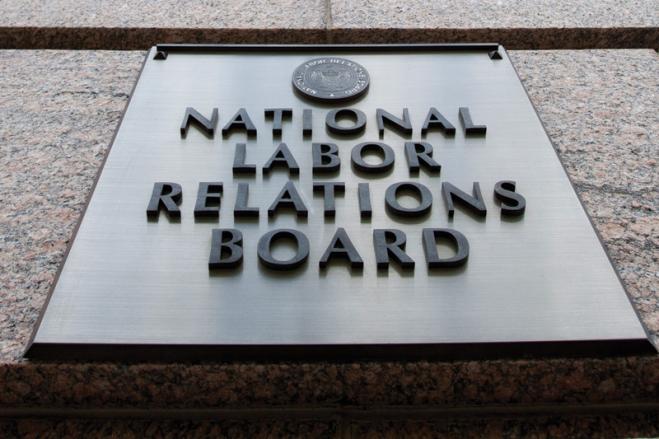
National Labor Relations Board Building SignLate last week the NLRB issued its long awaited decision in Browning-Ferris Industries – drastically expanding who may be considered a “joint employer” under the National Labor Relations Act (NLRA).

In Browning-Ferris, the company (“BFI”) had contracted with a labor services company – Leadpoint – to provide workers for BFI’s recycling plant.  The Leadpoint employees were hired and supervised by Leadpoint supervisors.  Their schedules were set by Leadpoint schedulers.  Any discipline was determined by Leadpoint managers.  However, under its contract with Leadpoint, BFI set requirements for candidates and retained the right to refuse or discontinue use of any employee.  Also, because of how the facility worked, BFI set the hours for the various shifts (though Leadpoint determined which workers would work each shift).

The Teamsters decided to organize the Leadpoint workers at the BFI facility.  However, instead of filing their petition for representation solely with regard to Leadpoint, the Teamsters filed their petition also naming BFI as the employees’ employer, on the theory that Leadpoint and BFI were joint employers and, as a result, that BFI could be required to negotiate the union.

The Board agreed with the Teamsters, holding that BFI was a “joint employer” of the Leadpoint employees.  As a result, the union was permitted to move forward with its petition.

In its decision, the NLRB rejected the prior test for joint employment – which required that an entity not only possess the authority to control employees’ terms and conditions of employment but also exercise that authority in a meaningful manner – and set a new rule:  that indirect or reserved authority, even if not exercised, can be sufficient to establish a joint employment relationship.

This ruling is particularly important for companies that work with subcontractors or staffing firms, or are themselves contractors or staffing firms.  Contracts governing staffing and subcontractor relationships regularly include provisions setting minimum standards for the individuals performing the services, the right to refuse workers or discontinue their use, and other requirements relating to the individuals who are performing the services.  There are strong business reasons to include these provisions, but, in light of the Board’s ruling in Browning-Ferris, companies need to be aware that the provisions which keep control over these aspects of the relationship also open the possibility that the company receiving the services will be deemed a joint employer under the NLRA.  Companies entering into these relationships should carefully weigh the benefits of control against the risk of being deemed to be a joint employer and reflect their desired balance in their contract, practice and procedures.